
+61 (04) 3599 1950
enquiries@biostatengineering.com
  • Home
  • About us
  • Services
  • Products
  • FAQ
  • Distributors
  • Contact Us

DWP(Dirty Water Plants) Series

July 27, 2016support
DWP Series Applications
DWP Series Components
DWP Series Applications

The Dirty Water Plants (DWP) comprise of models 20lpm – 300lpm treatment water flow rate. Designed as a water disinfection unit for use with water containing upper limit turbidity of approximately 100 NTU*. The treatment system combines flocculation, ozone disinfection, tetrasilver oxide (TST)for residual antibacterial/bacteriostatic function, sedimentary and activated carbon filtration. Flocculation of contaminants through addition of rapid action food grade flocculent to the system flocculation vessel, electrically generated ozone, erosion through agitation of TST balls in the water, specifically sized sedimentary filters and Inline solid block activated carbon filters (SBAC) combine to remove sedimentary contaminants, kill bacteria and other pathogens, and remove some pesticides from the treated water. Ozone and/or TST do not produce any taste or odour in the water. Activated carbon filters absorb organic compounds and can remove them from the water. These systems can remove volatile organic compounds, some pesticides, radon gas, hydrogen sulphide and mercury. The sedimentary filters remove sand and other particulate material.

* Not for sewage or waste water
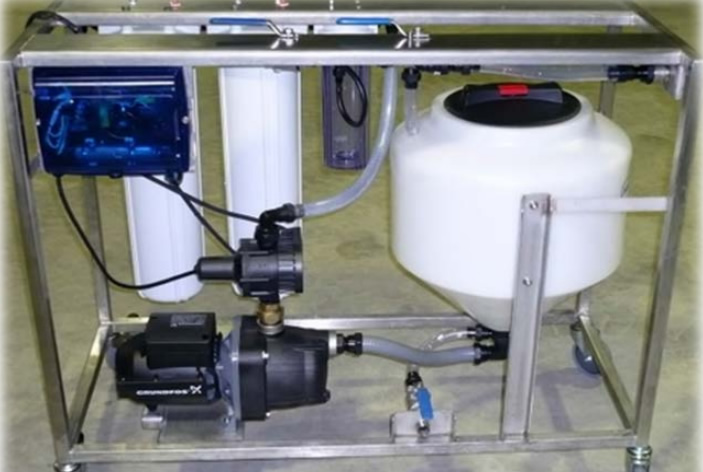
DWP Series Components
Biostat Cone Bottom Flocculation Vessel
DWP systems are equipped with an integrated flocculation vessel. The plant employs a batch treatment method. Treatment by flocculation of contaminated water before disinfection provides for more effective disinfection. Flocculation serves to remove a whole range of undesirable characteristics from the water. DWP plumbing allows for recirculation of water though diversionary valves, that exclude the raw water flow from the filters, while allowing the raw water exposure to ozone. Ozone acts on water contaminants in a way that is beneficial to subsequent flocculation of the treated (ozonated) water.

BacStop TST Dispenser
The BacStop TST technology is a method of treating water to kill bacteria and prevent the growth/re-growth of microbes harmful to humans and animals. Using metal ions, principally nano concentrations of polyvalent silver oxide. TST is released into the water by erosion of a solid balls made from silver oxide (TST). The balls are contained and dispensed from within a special inline dispenser. The system takes advantage of the oligodynamic effect provided by the addition of silver to water.

Sedimentary Filter
All machines have a cartridge filter system located after the BacStop dispenser. The filters are nominally rated at 1-10 micron (depending upon conditions), all particles larger than the specific sized filter will be removed from the inlet stream. The filter system is meant to remove large particles, which could impact upon the disinfection capabilities of the machine. The number of filter housings varies with the size of machine. Typically, other forms of filtration may precede the cartridge pre-filters.

Activated Carbon Filter
All machines utilize cartridge activated carbon (AC) filtration. AC is most effective in removing organic contaminants from water. Organic substances are composed of two basic elements, carbon and hydrogen. Because organic chemicals are often responsible for taste, odour, and colour problems, AC filtration can generally be used to improve aesthetically objectionable water. Similar to other types of water treatment, AC filtration is effective for some contaminants and not effective for others. AC filtration does not remove microbes, sodium, nitrates, fluoride, and hardness. Lead and other heavy metals are removed only by a very specific type of AC filter. The consumer should assume that the AC filter is not effective in removing them. Refer to the other available BWT information in the treatment of systems that do remove the contaminants listed above.

Ozone Generator
Ozone used as an alternative to chlorine for disinfection, not only reduces the formation of THMs and HAA, but is also effective as a disinfectant for the control of cryptosporidium, giardia and viruses. Ozonation has also been found to improve the taste, odour and colour of water. Ozone is an extremely strong oxidizing agent. In fact, ozone is so reactive to various water contaminants that it generally does not survive very long in the treatment process. Ozone reacts with natural organics in the water supply and forms lower molecular weight organic by-products that tend to be biodegradable.

Pumps
DWP series machines are equipped standard with Grundfos Centrifugal pumps (Other pumps types are optional). The pumps are specifically specified to deliver constant high-pressure flow ideal for water disinfection systems operation.

Pressure Gauges
DWP series machines include stainless steel, glycerin-filled pressure gauges mounted into various locations in the machine’s piping to yield pre-filter and post-filter pressure readings. The machines typically operate at a pre-filter pressure of 100 – 300 kPa with a 20 – 40 kPa pressure drop across the plant. Depends upon model and/or condition of filter element.

  • This field is for validation purposes and should be left unchanged.
DOWNLOAD TECH INFORMTION

Our Products

  • Accu-San
  • BoreVac
  • ChloSan
  • CWPUV(Clean Water Plant) Series
  • Drinksafe-3
  • Drinksafe-8
  • DWP(Dirty Water Plants) Series
  • HaloVac
  • Flowell
  • LakeVac
  • PolyVac
  • Screen Clean Plus
  • TIRM DMI65
©2016 Biostat Engineering site by:  cyanweb